
Dickson Parole and Probation Compared
The Tennessee Board of Parole decides discretionary parole. The Tennessee Department of Correction, or TDOC, supervises both parole and state probation in the field. Parole is a conditional release from confinement before the sentence expires. Probation is a court-ordered community sentence, either imposed directly or after a period of split confinement. A Dickson County Jail release entry can confirm that physical jail custody ended, but jail staff do not set the later terms of state parole. The Board is likewise not the record owner for an ordinary bond release from the county jail.
The distinction matters because each record answers a separate question. A Board grant may occur before the person actually leaves confinement while TDOC reviews a release plan and other requirements. A probation judgment can place someone in the community without any parole hearing. TDOC instructs a probationer released from split confinement to report within 48 hours. The court judgment, Board action, FOIL status, and field-office record should therefore be read as parts of one trail, not as interchangeable proof.
| Community status | Who authorizes it | Best verification |
|---|---|---|
| Parole | Tennessee Board of Parole | FOIL status, Board action, and TDOC office confirmation |
| Probation | Sentencing court | Judgment and TDOC supervision status |
| Determinate release | Statutory release route | TDOC sentence and supervision record |
| Mandatory reentry supervision | Tennessee law for covered cases | FOIL and TDOC sentence calculation |
| Community Corrections | Court sentence | Court file and supervising program |
Dickson Supervision Terms Defined
Tennessee uses several labels for community status. Reading the exact label prevents a county jail departure from being mistaken for a full discharge. It also keeps a Board hearing from being mistaken for a release event.
- Parole
- Conditional community release authorized by the Board before sentence expiration.
- Probation
- A court-ordered community sentence with rules enforced by a supervising authority.
- Discharge
- The formal end of the stated supervision or sentence obligation, as shown by the proper agency record.
- Absconder
- A person officially declared to have left supervision without permission. A missed appointment alone does not prove this status.
- Revocation
- An official decision that can cancel community release or probation after a violation process.
TDOC also lists determinate release and mandatory reentry supervision. Determinate release can place a qualifying person with a short felony sentence on special probation after statutory service and notice steps. Mandatory reentry supervision applies to covered felony offenses committed on or after July 1, 2021. Neither should be relabeled as discretionary parole.
Note: Community supervision is not jail custody, but it is also not an unconditional end to the sentence or court order.
Verify Dickson Post-Release Supervision
Start with the state record only when a state sentence or state supervision is plausible. TDOC Felony Offender Information Lookup, known as FOIL, covers felony offenders currently or formerly in TDOC custody or supervision. It can report a status such as incarcerated, parole, probation, or inactive. A person released from Dickson County Jail after bond, dismissal, a misdemeanor, or a locally completed sentence may never appear. For that county release, use the jail record and the relevant Dickson court instead.
- Search FOIL by the person’s name, TDOC or TOMIS number, or State ID Number. Use more than a name to confirm identity.
- Read the Status field first. “Parole” and “Probation” identify community supervision, while “Incarcerated” means state custody continues.
- Review location, sentence, offense, parole-hearing, and release information that appears on the matched detail record. Record the query date.
- Check the Dickson court judgment when probation was court ordered. General Sessions and Circuit records establish what the judge imposed.
- Contact the Charlotte TDOC field office for public verification or routing. Do not seek private schedules, treatment details, or residence information.
- For a parole decision, compare FOIL with the Board hearing or decision record. A grant is not proof that physical release occurred.
The complete Dickson County release path is covered on the Dickson County released-inmate search. That route helps distinguish a person who entered TDOC from one who simply left local jail custody.
Dickson Parole Office Details
Dickson has a local TDOC Community Supervision field office in Charlotte. It serves Dickson and Cheatham Counties within District 80, making it the closest state routing point for a Dickson parole or probation status question. District headquarters is in Clarksville, but the local office is the sound first contact when FOIL displays community supervision tied to this area. The office may confirm a public routing point, yet confidential reporting instructions are not public lookup material.
TDOC Community Supervision
Dickson/Cheatham Field Office
513 Spring Street
Charlotte, TN 37055
Phone: (615) 740-4766
Fax: (615) 446-4873
This local setup separates three record owners located in Charlotte. The jail owns the physical custody and departure record. The court clerk owns judgments and probation orders. TDOC owns the state supervision record. A shared city does not merge those files, so a caller should state which event needs confirmation.
Dickson Parole Hearings and Release
The Tennessee Board of Parole hearing schedule is refreshed weekly, usually Monday or Tuesday after a Monday holiday. Schedule requests can also go to BD.HearingSchedules@tn.gov, and changes can be checked at (615) 741-1150. The present Board site does not offer a stand-alone public decisions search. For one person, FOIL is the practical status check. Formal decisions may require an institutional probation or parole specialist, a Board inquiry, or a public-records request.
The schedule includes grant, revocation, rescission, time-setting, custodial, and appeal hearings. These labels do not all concern a first release. A hearing officer recommendation may still require Board votes. Even a grant does not equal a gate date because the plan, sentence calculation, holds, and other pre-release terms must clear.
The official weekly schedule is shown on the Board’s current hearing page.
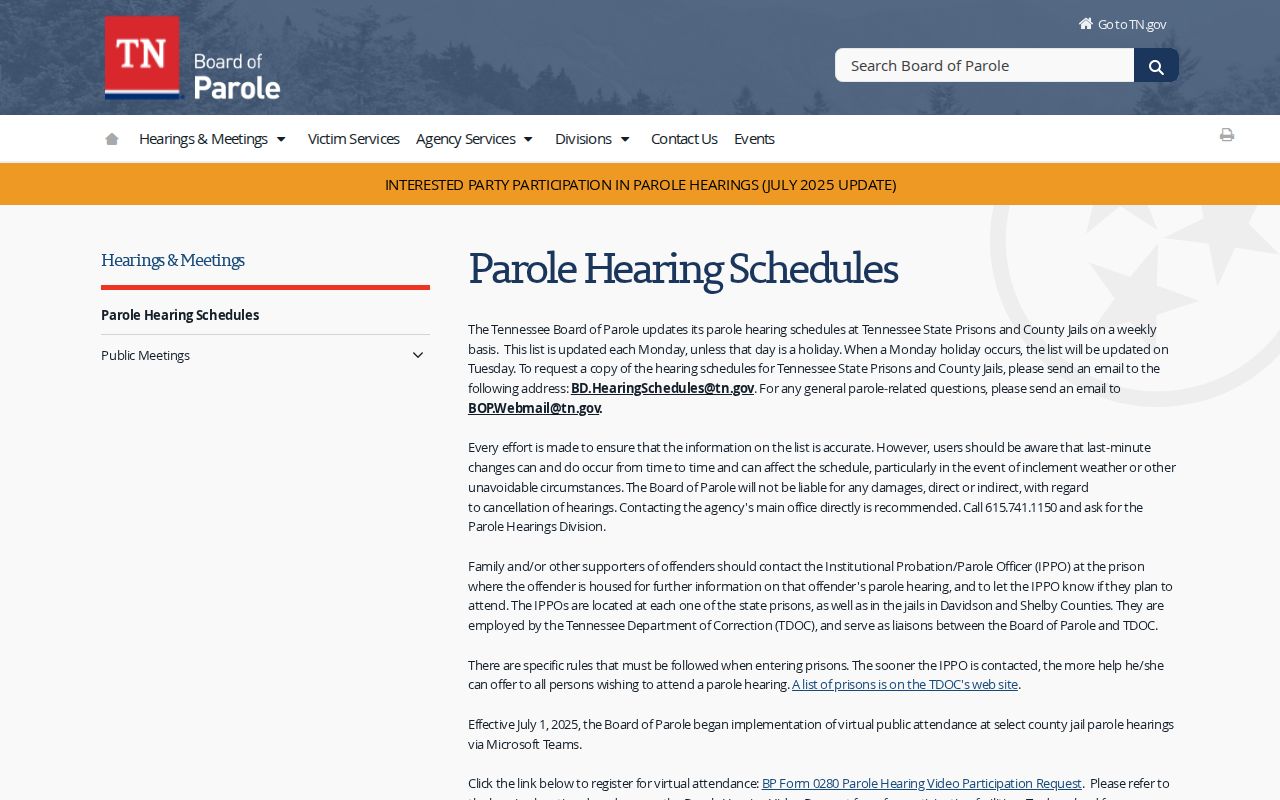
The schedule helps locate a proceeding, while FOIL, the final Board action, and TDOC confirmation establish the resulting status.
Note: Eligibility and a hearing date are milestones, not proof that a Dickson County person has been physically released.
Dickson Supervision Violations and Warrants
Conditions depend on the judgment, release certificate, and individual plan. Common subjects can include reporting, travel approval, treatment, fees, or compliance with court orders, but the actual record controls. A violation allegation can lead to a warrant, hearing, changed conditions, or revocation. It does not prove revocation by itself. The court or Board process must establish the result.
No public TDOC absconder list was found for Dickson County. An old address, an inactive FOIL record, or a missed office visit cannot support an absconder claim. Verify a warrant through the responsible court or law-enforcement agency. The Dickson County Sheriff Warrants Division maintains and validates wanted-person records, but its page does not publish a warrant list. A caller should give enough detail for an identity match and avoid asking for private supervision information.
Dickson Supervision Discharge Records
Supervision ends through the legal route that created it. A probation term can end under a court order or documented completion. Parole continues until the governing sentence or Board action permits discharge. Mandatory reentry and determinate release follow their own statutes. A jail release record proves only that a custody episode ended. It does not prove that TDOC supervision ended the same day.
Use the final court order for probation, the FOIL status and release details for a state offender, and the Board or TDOC record for parole. If an older FOIL entry lacks detail, TDOC’s archived-record process can locate state material. Ask for a record that states the end status and effective date rather than relying on a blank search result. “Inactive” is useful, but it should not be expanded into “sentence completed” unless TDOC or the underlying record confirms that meaning.
Records may also change after correction or expunction. Tennessee Code § 40-32-101 directs an expunction request to the court where the arrest or case began. A certified order is the key follow-up document if an agency display remains. It does not permit reconstruction of sealed material from unofficial copies.
Note: Roster absence does not prove release. Transfer is not community release. A charge or booking photo does not establish a conviction.