
Dickson Projected and Actual Release
A projected date is a calculation. An actual release is a completed custody event. Tennessee’s main FOIL field is called the Release Eligibility Date, or RED. Under Tennessee Code § 40-35-501(n), it is the earliest date a felony inmate may become eligible for parole, conditioned on behavior. It is not a promised gate date, sentence expiration date, or proof of release. The Board may deny or defer parole, a release plan may remain unapproved, or another valid hold may prevent departure.
County jail cases require another distinction. A person awaiting trial has no sentence-based release date. Bond can be posted, a judge can change conditions, a charge can be disposed of, or another warrant can keep the person held. A locally sentenced person may have a calculable term, but the Dickson County Jail and the sentencing court must identify the judgment, credits, and other holds. A person transferred from Dickson County Jail into TDOC custody has left the jail without being released to the community.
Find a Dickson Release Date
The right search begins with custody type. Dickson County has no public sheriff roster or projected-date portal. TN SAVIN can report a county custody event, but it is not the archival sentence calculator. FOIL is useful for a felony offender currently or formerly in TDOC custody or supervision. It may not include someone who left the county jail after bond, dismissal, a misdemeanor, or a locally completed sentence.
- Identify the current or last custodian. Call Dickson County Jail at (615) 789-4109 when local custody is possible.
- Obtain the judgment and offense date from the proper Dickson court. Ask for later amended judgments and revocation orders too.
- For a state felony case, open TDOC FOIL and match the person by name plus an identifier when possible.
- Read Status first, then review active sentences, Release Eligibility Date, parole-hearing date, and expiration or release information when populated.
- Check whether sentences run at the same time or back to back, and confirm jail credit, statutory exclusions, and retained earned credits with the record owner.
- After the displayed date, verify the actual custody or supervision status. Never backfill an assumed release event.
For a named-person search that must also trace a county release, court record, or federal handoff, use the Dickson County released-inmate lookup. That broader trail prevents FOIL from being used for someone who never entered the state system.
Note: FOIL follows eligible state offenders across Tennessee, not every person booked and released by the Dickson County Jail.
Dickson TDOC Release-Date Fields
TDOC says FOIL can display an offender photograph, status, location, offenses, sentence information, parole-hearing status, and release information. Search paths include last and first name with optional race and aliases, TDOC or TOMIS number, and State ID Number. The CAPTCHA is case sensitive. Match more than a common name, and save the date of the lookup because status can change.
| FOIL item | What it can establish | What it cannot establish alone |
|---|---|---|
| Status | Incarcerated, parole, probation, or inactive state status | The exact Dickson jail departure time |
| Release Eligibility Date | Earliest parole eligibility under the current calculation | A promised physical release |
| Parole Hearing Date | A scheduled state parole step | A final grant or approved plan |
| Sentence information | Active state terms reported by TDOC | Unentered court changes or unrelated holds |
| Release information | State event details when populated | A county-only bond or dismissal record |
The official TDOC FOIL description shows the categories offered for a Tennessee felony offender.
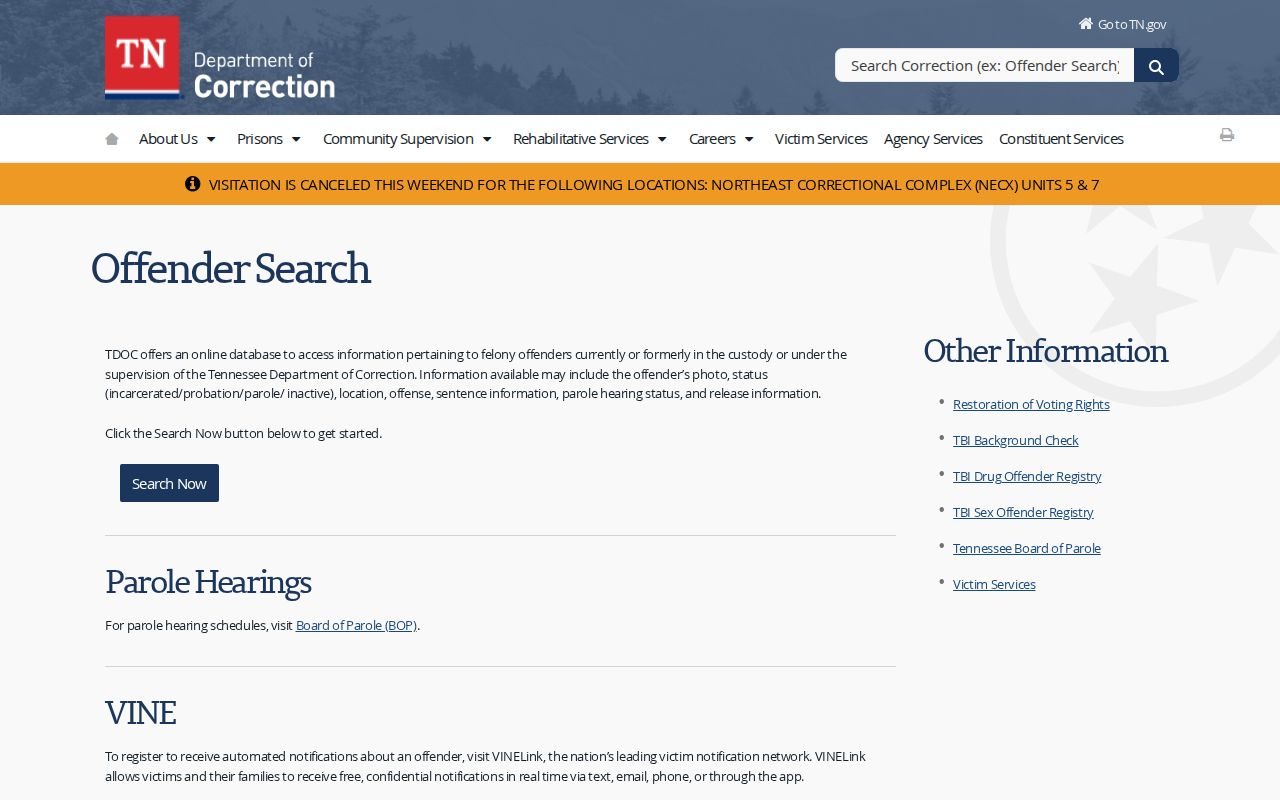
The description confirms FOIL’s state scope. It does not turn the service into a Dickson County jail roster or local release log.
Dickson Release Eligibility Percentages
Tennessee has no single rule that every person serves 85 percent. Section 40-35-501 supplies general eligibility points and many offense-specific rules. Especially mitigated offenders may have a 20 or 30 percent point as stated in the judgment, with 20 percent if the judgment is silent. General ranges include 30 percent for Range I standard offenders, 35 percent for Range II multiple offenders, 45 percent for Range III persistent offenders, and 60 percent for career offenders. Some repeat violent or life-without-parole statuses have no eligibility.
Those figures are only starting frameworks. Several sections require 85 percent, 100 percent, or limit the credits that may reduce service. Examples include specified serious offenses under subsection (i), certain aggravated robbery date windows, and newer no-release-eligibility provisions. Section 39-13-523 separately requires full service for specified sexual offenses. The conviction statute, offense date, judgment, range, and every applicable special rule must match before a percentage is used.
A release estimate based on the charge name alone can be badly wrong. Charges may change before judgment, and offenses with similar names can carry different statutory rules by date. Obtain the signed judgment and let TDOC calculate covered felony sentences.
Dickson Good-Time Release Credits
Under Tennessee Code § 41-21-236, an eligible person may receive up to 16 days of sentence credits per month. No more than eight days are for good institutional behavior, and up to eight are for satisfactory program performance. Credits are awarded monthly after documentation. They are not automatic rights. Disciplinary proceedings can remove credits, and maximum-security or punitive-segregation status can affect the ability to earn them.
Qualifying educational or intensive-treatment achievements can carry statutory 60-day credits, subject to exclusions. For covered felony sentences of one year or more served locally, the state framework applies. Local misdemeanor sentences have a separate rule in § 41-21-236(f): the court sets a release percentage from 30 through 100 percent in ten-point steps, and credits cannot reduce it by more than 25 percent. Rules after July 1, 2024 also distinguish whether credits alter sentence expiration or only parole eligibility, especially for felony sentences of two years or more.
Good time therefore does not mean time simply disappears. The record must show which credits were earned and kept, which sentence they affect, and whether they move eligibility or expiration. TDOC’s calculation controls for covered felony terms.
Note: Ask for the current credit calculation and judgment; a hand estimate cannot account for every offense-date rule or later adjustment.
Why Dickson RED Is Not Release
Dickson’s key release-date quirk is Tennessee’s use of RED. The label answers when parole consideration may first be possible, not when a person must leave. Section 40-35-501(r) assigns TDOC the calculation of expiration and eligibility dates for felony offenders sentenced to TDOC and felony offenders serving one year or more in a local jail or workhouse. Subsection (m) requires separate work by offense and aggregation of ineligible periods for consecutive sentences.
Eligibility is just one gate. The Board must grant parole when parole is available, TDOC must verify sentence authority, and a release plan must be approved. TDOC Policy 511.03 calls for checks of detainers, notices, judgments, revocations, sentences, and Board documents. An old eligibility date may remain visible even though a later disciplinary event, amended judgment, or unresolved plan changed the path.
This is why an expired date in a search result cannot safely be described as the actual release date. Read current status and release information. Then ask TDOC about the exact meaning of the field for that record.
Dickson Release Dates Can Change
Release-date calculations are built from several records. A change to one can move the outcome. Some factors affect eligibility, some affect sentence expiration, and others stop a planned physical exit without changing the sentence math.
| Factor | Possible effect | Record to verify |
|---|---|---|
| Earned or lost credits | Moves an allowed eligibility or expiration calculation | TDOC sentence-credit record |
| Discipline | Can defer eligibility or remove credits | TDOC disciplinary and calculation record |
| Concurrent or consecutive terms | Changes how sentence periods combine | Every signed judgment |
| Pretrial jail credit | Changes credited sentence time | Judgment and jail-credit calculation |
| Detainer or another case | May cause transfer or continued custody | Holding and receiving agencies |
| Parole action and plan | May grant, deny, defer, or delay an exit | Board action and TDOC approval |
| Amended judgment | Can alter the legal sentence inputs | Sentencing court file |
A detainer is a request or notice that another authority may take custody. It can turn a jail departure into a transfer. The releasing agency should identify the destination rather than simply saying the person is “gone.”
Confirm Dickson Actual Release
After the expected date, check the current record again. For a Dickson County Jail case, call the jail and request the public release or custody-exit record if the answer is not clear by phone. Ask for date, time, event type, and receiving agency when a transfer may have occurred. A court order supplies legal authority but may not show the exact moment the door opened.
For a TDOC offender, read the current FOIL status and populated release information. Parole means community supervision, while incarcerated means state custody continues. Inactive can describe a former state record, but it should not be translated into sentence completion without confirmation. TN SAVIN/VINELink may send an event alert for a participating county or TDOC record. The Dickson VINELink inmate search explains how to follow the specific person and verify the source agency.
If FOIL lacks older details, TDOC provides an archived-record request route. Supply the identity details through the agency’s secure process, and do not publish sensitive identifiers. Keep the query date and the final agency response with any date used in a court or legal process.
Note: Roster absence does not prove release. Transfer is not community release. A charge or booking photo does not establish a conviction.